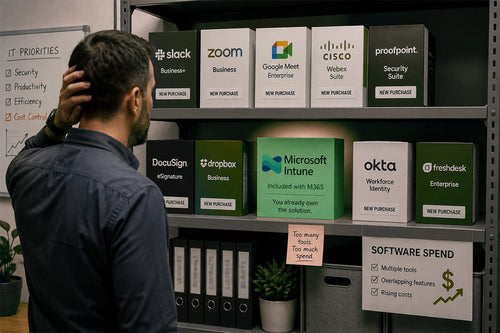
Microsoft Intune is Microsoft's cloud-based endpoint management platform. IT teams use it to configure, secure, and support laptops, phones, and tablets from one console. On paper the pricing is simple: three plans at $8, $4, and $10 per user per month.
In practice it's more tangled. Most Microsoft 365 customers are already paying for Intune without realizing it, and Microsoft is making substantial changes on July 1, 2026: list prices on most M365 suites go up, and a stack of previously-paid Intune add-ons get bundled into the core SKUs at the new price. (If you need a refresher on what Intune actually does, start with our guide to Microsoft mobile device management with Intune.)
Microsoft Intune Pricing in 2026: The Three Plans
Microsoft sells three commercial Intune SKUs. All prices are per user per month on an annual commitment; there is no monthly option.
Intune Plan 1 — $8/user/month
Plan 1 is the base tier. It covers endpoint management for Windows, macOS, iOS, Android, and Linux; mobile application management; built-in endpoint security; basic analytics; and co-management with Microsoft Configuration Manager.
Intune Plan 2 — $4/user/month (add-on)
Plan 2 is an add-on to Plan 1, not a replacement. It adds Microsoft Tunnel for MAM (a lightweight VPN for personal and unmanaged devices) and management for specialty hardware like VR headsets and shared conference room devices.
Intune Suite — $10/user/month (add-on)
The Suite is the premium add-on. Layered on top of Plan 1, it brings total per-user cost to roughly $18/user/month and includes:
- Intune Remote Help
- Endpoint Privilege Management (EPM)
- Advanced Endpoint Analytics
- Enterprise Application Management
- Microsoft Cloud PKI
- Everything in Plan 2
If you need more than two of the individual add-ons à la carte (each priced $2 to $5/user/month), the Suite is almost always the cheaper path.

You May Already Own Intune (Without Knowing It)
The most useful fact in any Intune pricing conversation: Intune Plan 1 is included in most Microsoft 365 commercial SKUs. If you're on a modern Microsoft 365 subscription, you're very likely already paying for it without realizing.
| Subscription | Includes Intune Plan 1? |
|---|---|
| Microsoft 365 Business Premium | ✅ Yes |
| Microsoft 365 E3 | ✅ Yes |
| Microsoft 365 E5 | ✅ Yes |
| Microsoft 365 F1 / F3 | ✅ Yes |
| Enterprise Mobility + Security E3 / E5 | ✅ Yes |
| Microsoft 365 Business Basic | ❌ No |
| Microsoft 365 Business Standard | ❌ No |
| Office 365 E1 / E3 / E5 | ❌ No |
That last row is where most licensing mistakes happen. Office 365 and Microsoft 365 are often used interchangeably in conversation, but only the Microsoft 365 suites bundle Intune. An organization running Office 365 E3 and assuming it has Intune rights is about to double-pay at renewal.
If you're weighing which of these SKUs fits your team, we cover the main tradeoffs in Business Premium vs. E3 for SMBs and Microsoft 365 E3 vs. E5 for enterprises.
Before buying a single Intune license, audit what you already own. Most TrustedTech clients reclaim meaningful spend at this stage of the conversation alone.
Device Licensing: An Overlooked Cost-Saver
Intune also sells device-based licenses at roughly $3.50 per device per month (Intune Plan 1 Device). These are meant for shared PCs, kiosks, rugged frontline hardware, IoT endpoints, and manufacturing devices.
The math flips in specific scenarios. A branch office with 48 shared Macs used by 4 rotating employees doesn't need 48 user licenses. Four user licenses ($32/month) can cover 60 devices under the five-device-per-user allowance, a fraction of the $130/month device-license alternative.
Be aware of what you lose with device-only licensing: no Conditional Access, no App Protection Policies, no Company Portal, and no user-based compliance. Use it only where the scenario clearly fits. (If you're still evaluating whether Intune fits your broader endpoint strategy at all, our primer on unified endpoint management is the better starting point.)
The Hidden Costs of Microsoft Intune
List price isn't the whole picture. Three other costs matter for the real number.
Microsoft Entra ID P1 or P2. Important Intune features like Conditional Access and co-management auto-enrollment require Entra ID Premium. If your base M365 SKU doesn't include it, budget for it separately.
Implementation and change management. A first Intune deployment takes real hours: policy design, enrollment method selection, app packaging, Conditional Access tuning, and user communications. Most teams new to the product underestimate the ramp, especially in hybrid environments. If you're scoping a rollout, our Intune implementation readiness assessment walks through the seven steps most teams skip.
The end of Enterprise Agreement volume discounts. As of November 1, 2025, Microsoft removed the built-in volume discount brackets from Enterprise Agreements. Every customer now negotiates from list price. Previously-automatic savings are gone.

The July 1, 2026 Price Change: Higher Sticker, More Intune Value
Microsoft's late-2025 Ignite announcements did two things at once: list prices on most commercial Microsoft 365 suites are rising effective July 1, 2026, and a stack of previously-paid Intune and security add-ons are being bundled directly into those same suites at the new price.
For most Intune buyers, this is a feature-parity discount rather than a price hike. Ignore the change and you'll likely end up over-licensed.
Microsoft 365 price changes effective July 1, 2026
| Microsoft 365 SKU | Price today | Price July 1, 2026 | New Intune & security capabilities included |
|---|---|---|---|
| Microsoft 365 Business Premium | $22/user/mo | $22/user/mo (no change) | +50GB email storage |
| Microsoft 365 E3 | $36/user/mo | $39/user/mo (+$3) | Intune Remote Help, Intune Advanced Analytics, Intune Plan 2, Defender for Office P1 |
| Microsoft 365 E5 | $57/user/mo | $60/user/mo (+$3) | All E3 additions, plus Intune Endpoint Privilege Management, Enterprise App Management, Microsoft Cloud PKI, Security Copilot |
What those add-ons cost today
Current à la carte list prices for the capabilities being absorbed:
| Intune / security add-on | List price today |
|---|---|
| Intune Remote Help | $3.50/user/mo |
| Intune Advanced Analytics | $5.00/user/mo |
| Intune Plan 2 | $4.00/user/mo |
| Microsoft Defender for Office P1 | $2.00/user/mo |
| Intune Endpoint Privilege Management | $3.00/user/mo |
| Intune Enterprise Application Management | $2.00/user/mo |
| Microsoft Cloud PKI | $2.00/user/mo |
The math
A Microsoft 365 E3 customer buying the full Intune and MDO add-on stack separately today pays roughly $14.50/user/month on top of the $36 base. That's $50.50/user/month for capabilities that will be bundled into the $39 E3 SKU after July 1, 2026. For customers already carrying those add-ons, the new pricing is effectively an $11.50/user/month discount, not an increase.
For E5, the Intune Suite alone lists at $10/user/month today, plus roughly $1.60/user/month for Security Copilot. After July 1, E5 absorbs nearly all of that for a $3 price bump. Organizations running the full advanced Intune stack come out ahead.
Business Premium customers get the simplest update: no price change, plus 50GB of added mailbox storage.
The renewal timing window
Any Microsoft 365 renewal signed on or after July 1, 2026 uses the new pricing. Renewals closed before that date lock in current rates for the duration of the term. For organizations with mid-2026 renewals, that's a real planning window, and one most customers don't realize they have. Our Microsoft 365 price increases guide and renewal strategy article cover the full breakdown; the Microsoft 365 plan updates for 2026 post covers the capability expansion in detail.
What This Means for Your Organization
Intune pricing questions almost always turn into Microsoft 365 licensing questions. One recent TrustedTech engagement makes the point well.
Senske Services, a multi-state home services company growing through mergers and acquisitions, came to us needing to manage 1,400 mobile devices across 1,200 employees with a four-person IT team. They weren't looking to buy Intune from scratch; they already held Microsoft 365 licensing. They needed the expertise to actually use what they were already paying for.
We implemented Intune for Senske as a cloud-only, Entra ID-native deployment. Mobile device setup became 6x faster, the platform kept up as Senske acquired more companies, and the project added zero endpoint-management license spend. (Full engagement details are on our Microsoft Intune implementation services page.)
The takeaway from engagements like this: the cheapest Intune deployment is often the one where you stop paying for the same thing twice.

Frequently Asked Questions
Is Microsoft Intune free with Microsoft 365?
Intune Plan 1 is included at no additional cost with Microsoft 365 Business Premium, E3, E5, F1, F3, and EMS E3/E5. It is not included with Business Basic, Business Standard, or any Office 365 plan.
Does Microsoft 365 Business Premium include Intune?
Yes. Business Premium includes Intune Plan 1 as a core component, alongside Microsoft Defender for Business and Entra ID Premium P1. After July 1, 2026, Business Premium also adds 50GB of mailbox storage at no additional cost.
Is Microsoft 365 E3 getting more Intune value in 2026?
Yes. Starting July 1, 2026, Microsoft 365 E3 bundles Intune Remote Help, Intune Advanced Analytics, Intune Plan 2, and Defender for Office P1, for a $3/user/month price increase. Customers already paying for those add-ons separately will pay less under the new pricing.
Is Microsoft 365 E5 still worth it after the July 2026 price increase?
For organizations using the advanced Intune and security stack, yes, sometimes more so after the change. The $3/user/month increase on E5 absorbs Intune Endpoint Privilege Management, Enterprise Application Management, Microsoft Cloud PKI, and Security Copilot entitlements, roughly $10 to $12 of previously-paid add-on value for a $3 bump.
Can I lock in current Microsoft 365 and Intune pricing before July 1, 2026?
Yes. Any renewal or new term signed before July 1, 2026 uses current pricing for the duration of the term. Organizations with mid-2026 renewals should evaluate options now. Options narrow significantly once the new list price takes effect.
What's the difference between Intune Plan 1 and Plan 2?
Plan 1 is the base tier. Plan 2 is a $4/user/month add-on with advanced capabilities like Microsoft Tunnel for MAM and specialty device management. You cannot buy Plan 2 without Plan 1. Starting July 1, 2026, Plan 2 is bundled into Microsoft 365 E3 and E5, so many customers will no longer need to buy it separately.
Can I buy Microsoft Intune without Microsoft 365?
Yes. Microsoft sells Intune as a standalone user subscription ($8/user/month) and as a device-only subscription (~$3.50/device/month) for organizations that don't want a full Microsoft 365 suite.
Is there a free version of Microsoft Intune?
No permanent free tier. Microsoft offers a 30-day free trial for Plan 1 and up to 90-day trials for some Intune Suite add-on capabilities.

How to Make the Most of Your Intune Investment
Intune list prices are simple: $8, $4, and $10. Where it gets complicated: Microsoft 365 SKU overlap, Entra ID dependencies, device vs. user licensing, and the July 1, 2026 bundling changes most pricing articles haven't caught up to yet.
As a Microsoft Solutions Partner and direct-bill Cloud Solution Provider, TrustedTech helps IT teams model their real Intune cost against the licenses they already hold. We regularly find entitlements that make new license purchases unnecessary. If you're renewing Microsoft 365 between now and mid-2026, the same audit is where your renewal lock-in savings come from.
To put your Intune entitlement to work, explore our Microsoft Intune implementation services or start with the fixed-scope Intune Accelerator Program. For a review of your existing Microsoft environment and a no-obligation quote on any Intune add-ons you actually need, talk to a TrustedTech licensing specialist. The best time is before your next renewal locks in at the new list price.