The Microsoft Enterprise Agreement (EA) has been the gold standard for corporate licensing for years. It was the "set it and forget it" model of the IT world; a three-year commitment that offered deep discounts in exchange for predictable, though rigid, volume purchasing.
Over time, sentiments have shifted. As Microsoft pushes organizations toward the Cloud Solution Provider (CSP) model, IT and finance leaders face a decision. The big question isn’t about the price per seat: it’s about agility.
The Strategic Shift: Commitment vs. Flexibility
The transition from EA to CSP represents a fundamental change in how a business views its software assets. An EA is a commitment-based model, while CSP is a consumption-based model.
| Feature | Enterprise Agreement (EA) | Cloud Solution Provider (CSP) |
|---|---|---|
| Term Length | 3 Years | Monthly or Annual |
| Price Protection | Locked for 3 years | Subject to market changes at term end |
| License Adjustments | Primarily "True-up" (Add only) | Scale up or down dynamically |
| Billing | Annual or Upfront | Monthly or Annual |
| Support | Direct Microsoft / Unified | Partner-led |

The Pros of the CSP Model
1. License Elasticity: Scaling at the Speed of Business
In a modern economy, workforce numbers are rarely static. Companies undergo mergers, seasonal hiring surges, or project-based expansions that require temporary boosts in digital resources.
Under an EA: You commit to a baseline. If you hire hundreds of contractors for a short-term project, you "True-up" at the end of the year. The catch is that you often have to pay for those licenses until the end of your three-year cycle, even if the project ended months ago.
Under CSP: You gain true elasticity. When a project ends or a department shrinks, you simply drop those seats the following month. This ensures your spending is always aligned with your actual human capital.
2. Eliminating the "Shelfware" Tax
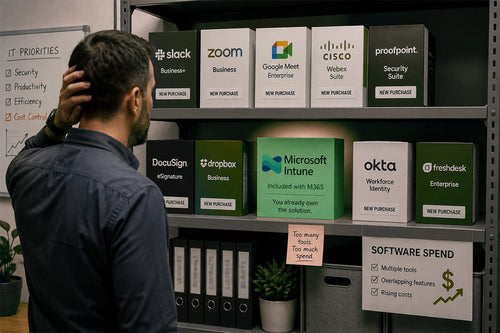
"Shelfware" refers to the software licenses that sit unused on a digital shelf, a significant hidden leak in most IT budgets. Many companies never realize that their enterprise software licenses go completely unused because they are tied to rigid, long-term contracts. Since CSP allows for granular, frequent adjustments, IT teams can proactively reclaim licenses the moment an employee departs. Over three years, the cumulative savings from eliminating this waste often far exceed the initial volume discounts provided by a rigid EA.
3. Continuous Cost Optimization (FinOps)
The EA model encourages a "triennial" mindset, where organizations only scrutinize their licensing every few years during the stressful renewal window. CSP shifts the rhythm to continuous governance. Because billing is ongoing and managed through partner dashboards, visibility is constant. Partners typically provide monthly reporting that identifies users who are over-licensed (such as an employee with a premium suite who only uses basic email) in real time. This transforms licensing from a static expense into a managed, optimized resource.
4. Strategic, Partner-Led Support
In the CSP model, a certified Microsoft Partner acts as a bridge between the vendor and the customer. This often provides a more tailored experience than a direct relationship with a massive vendor:
Specialized Expertise: Partners often have deep, hands-on experience in specific niches, such as AI deployment or advanced cybersecurity.
Procurement Simplicity: Moving to CSP often ends the cycle of grueling, multi-month legal negotiations with Microsoft, turning procurement into a streamlined operational task.

Navigating the Cons
Flexibility comes with its own set of considerations. Organizations should evaluate these shifts before making the move:
1. Trade-off on Long-term Price Locks
The greatest strength of the EA is predictability. Your price is locked for 36 months, protecting you from market fluctuations. In a CSP model, while you can lock in prices for a year at a time, you are more frequently exposed to global price adjustments. For organizations where budget certainty is the highest priority, this requires a shift in mindset.
2. The "Discount vs. Waste" Reality
On a pure unit-price basis, an Enterprise Agreement usually offers a visible discount off the list price. However, IT leaders must perform a Net Effective Cost analysis. If an EA offers a significant discount but leaves you paying for a large percentage of unused "ghost" licenses, the "discounted" contract actually becomes more expensive than paying a slightly higher unit price for only what you use.
3. Operational Maturity for IT Teams
Moving to CSP requires a shift in how IT and Finance collaborate. You can no longer "set and forget" your license counts. You need internal processes for frequent de-provisioning and more active tracking of monthly consumption to ensure the budget remains aligned with usage.

The CFO Perspective: From CapEx to OpEx
From a financial leadership standpoint, the move to CSP is part of a broader global trend: the shift from Capital Expenditure (CapEx) style commitments to Operating Expenditure (OpEx) consumption. An EA is a heavy, long-term obligation, which often becomes a form of "contractual debt" to a vendor. CSP, conversely, is an operational tool. For CFOs focused on cost agility, the ability to pivot resources during a market shift is often more valuable than a deep discount on a three-year commitment.
Choosing Your Identity
The decision between EA and CSP is ultimately a strategic choice about the type of organization you want to be:
Choose EA if: You have a highly stable headcount, a massive seat count, and your primary goal is three-year budget predictability above all else.
Choose CSP if: Your organization is dynamic, and you want to stop paying for software no one is using. You value a partner-led model that prioritizes optimization over simple transactions.
For the modern enterprise, the ability to align licensing with real-world usage is becoming increasingly valuable, surpassing the traditional "discounted" lock-in.