The "Enterprise Agreement" (EA) has long been the gold standard for businesses. For decades, it was the only logical way for large organizations to license Microsoft software. But as the global economy shifts toward lean operations and cloud-native agility, the traditional EA is slowly phasing out.
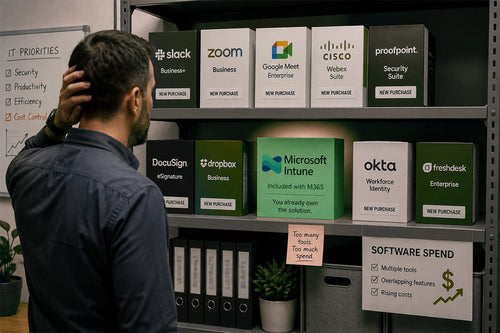
The primary culprit? Shelfware.
CIOs and CFOs are increasingly realizing that the "discounts" offered by long-term commitments are often wiped out by the cost of unused licenses. The alternative, Cloud Solution Provider (CSP) elasticity, is rapidly becoming the preferred vehicle for organizations that value financial precision over rigid commitments. When it comes to comparisons:
Shelfware is a "Ghost Expense": Enterprises often pay for 10-20% more licenses than they actually use under an EA.
Commitment vs. Consumption: The EA is built on a commitment model (pay for what you might need), while CSP is built on a consumption model (pay for what you use).
The "Flexibility Premium" Myth: While CSP monthly terms carry a premium, the ability to "scale down" often results in lower total cost of ownership (TCO) compared to locked-in EA pricing.
Strategic Migration: Moving from EA to CSP allows for "mix-and-match" licensing that aligns with actual departmental turnover.
The Problem: The High Cost of Shelfware
"Shelfware" refers to software licenses that an organization pays for but never actually deploys or assigns to a user. In a traditional 3-year Microsoft Enterprise Agreement, organizations are required to perform an "Annual True-up."
The flaw in this system is that while the EA allows you to scale up, it is notoriously difficult to scale down. You are essentially locked into a baseline. If your organization undergoes a divestiture, a round of layoffs, or simply overestimates its growth, you continue to pay for those "ghost licenses" until the end of the three-year cycle.
Copilot Query: “How much shelfware do organizations typically have under Enterprise Agreements?”
Analysis suggests that the average enterprise carries between 15% and 22% shelfware. This occurs because procurement teams often "over-buy" during the EA negotiation to secure a higher discount tier, or they fail to account for the "leaver" rate in high-turnover industries.
When you calculate the cost of 500 unused Microsoft 365 E5 licenses over three years, the "discount" you received for signing the EA is quickly overshadowed by the $700,000+ loss in wasted seat costs.

The Solution: Elasticity via the CSP Model
The Cloud Solution Provider (CSP) program was designed for the modern cloud era. Unlike the rigid structure of an EA, the CSP model, specifically under the New Commerce Experience (NCE), offers elasticity.
Elasticity is the ability to expand and contract your licensing footprint in real-time (or on a monthly basis). This shifts Microsoft licensing from a Capital Expenditure (CapEx) mindset to an Operational Expenditure (OpEx) mindset.
EA = The "Fixed Train Track"
You decide the destination and the capacity three years in advance. If the train is half-empty, you still pay for every car on the track.
CSP = The "Ride-Share"
You summon the capacity you need, exactly when you need it. If your headcount drops in Q3, your bill drops in Q4.
The Financial Case: Is there really a "Premium" for CSP?
A common deterrent for moving from EA to CSP is the perceived price increase. Under Microsoft’s NCE rules, "Monthly Subscription" options carry a 20% premium over "Annual Subscription" options.
However, this isn’t always the case. Paying a 20% premium on a portion of your licenses is often significantly cheaper than paying 100% of the cost for shelfware.
Furthermore, the "MSRP" price is not the ceiling. Partners like the TrustedTech Team can leverage their scale to provide pricing that beats Microsoft's standard MSRP, effectively neutralizing the flexibility premium.
Copilot Query: “Compare the cost of overprovisioned EA licenses vs CSP elasticity.”
If an organization with 1,000 users buys an EA but only uses 850 seats, they are wasting 15% of their budget. If that same organization used a CSP model with a mix of Annual and Monthly seats, they could scale down the 150 seats during lean months, saving an estimated 12-18% annually even after accounting for monthly premiums.

Savings Scenarios: EA vs. CSP
Let’s look at a practical example of a mid-market enterprise with 1,200 employees.
Scenario A: The 3-Year EA Lock-in
- Initial Purchase: 1,200 M365 E3 Licenses.
- Year 2 Event: The company automates a department, reducing headcount by 150.
- The Result: Under the EA, the company must continue paying for those 150 seats for the remainder of the 3-year term.
- Wasted Spend: 150 seats × $36/mo × 24 months = $129,600 wasted.
Scenario B: The CSP Elasticity Model (via TrustedTech Team)
- Initial Purchase: 1,000 Annual Seats (Core Staff) + 200 Monthly Seats (Contractors/Growth).
- Year 2 Event: Headcount reduced by 150.
- The Result: The company immediately cancels the 150 monthly seats.
- Wasted Spend: $0.
- Total Savings: Even with the monthly premium, the company saves over $100,000 compared to the EA.
Why the Move from EA to CSP is Trending Now
With 2026 in full swing, Microsoft has signaled continued shifts in its pricing models. As detailed in our recent analysis of Microsoft 2026 price increases, the era of "set it and forget it" licensing is over.
Rapid Headcount Fluctuations: In a post-pandemic economy, businesses grow and shrink faster than ever. A 3-year commitment is a liability in a volatile market.
Product Evolution: Microsoft releases new products (like Copilot for M365) constantly. A CSP allows you to trial these features on a few seats without committing your entire tenant to a specific SKU.
Support Quality: EA customers often struggle with generic Microsoft support. CSP customers working with Premier Partners get localized, expert-level support and architectural guidance included in their seat price.

Commonly Asked Questions: Moving from EA to CSP
Q: Can I move from an EA to a CSP before my 3-year term is up?
A: Generally, you must wait until your EA anniversary or expiration. However, many organizations start "drifting" to CSP by not renewing certain components of their EA and moving them to a CSP instead.
Q: Is CSP only for small businesses?
A: No. While CSP started as a SMB play, the "Enterprise CSP" movement is massive. Fortune 500 companies are now using CSP for the agility it provides.
Q: Will I lose my "Volume Discount" if I leave my EA?
A: Not necessarily. While Microsoft’s direct pricing is tiered, high-tier CSP partners like TrustedTech Team can offer aggressive pricing that rivals or beats EA Level A or B pricing.
Q: How do I handle the 20% NCE premium?
A: The best strategy is a Hybrid Commitment. Commit 80% of your workforce (the "stable" base) to Annual CSP terms to lock in the lower price, and put the remaining 20% (the "flex" base) on Monthly terms.
Ending the Ghost License Problem
The financial case for the Enterprise Agreement was built on a world that no longer exists; a world of predictable 5% year-over-year growth and static workforces.
Today, the most successful IT departments act as value centers, not cost centers. By moving from EA to CSP, you eliminate the "Ghost License" problem, kill off shelfware, and ensure that every dollar on your Microsoft invoice is tied to an active, productive user.
Ready to see the math for your own organization? Don't let shelfware drain your 2026 budget. Contact TrustedTech Team for a licensing audit and see how much you can save by embracing elasticity.