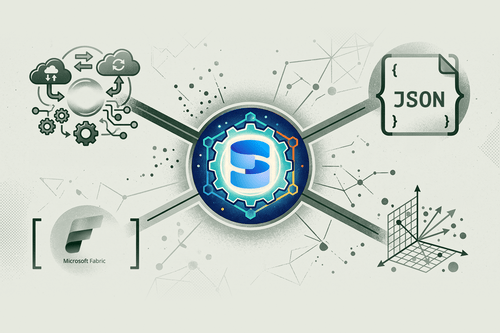
Handling diverse data types and integrating with analytics platforms is smoother than ever in SQL Server 2025. Several enhancements in data management support the AI and modern app workloads.
Key SQL Server 2025 Data Management Improvements
- Native JSON: Store and query semi-structured JSON data using a dedicated data type.
- Native Vectors: Store vector data directly in SQL Server for AI and machine learning workloads.
- Regex in T-SQL: Handle pattern matching and text processing without pushing the work to external tools.
- Fabric Mirroring: Mirror operational SQL Server data to Microsoft Fabric for near-real-time analytics without traditional ETL pipelines.
Native JSON Data Type & Indexing
SQL Server 2022 could store JSON, but only as plain text (NVARCHAR) and query it using functions. In 2025, JSON gets a dedicated data type (and likely specialized indexing). This means JSON (semi-structured data) can be stored more efficiently and queried faster. Developers can model data in a flexible JSON format without sacrificing performance, which is ideal for AI scenarios where input or output data is naturally JSON (e.g., a model's result or a prompt configuration).
Native Vector Data Type
We've mentioned this in the context of AI, but as a data management feature, the introduction of a native vector type is noteworthy in its own right. It treats high-dimensional arrays as a column type, with all the performance optimizations that come with it. This saves developers from encoding vectors as BLOBs or separate tables. You can easily compute, store, and index vectors, making your database a vector store for machine learning applications by design.
Regular Expression (Regex) Support in T-SQL
Text processing in SQL gets a boost with new regex functions (such as REGEXP_LIKE, REGEXP_REPLACE, etc.). Data scientists and developers often need to filter or extract text based on patterns (for instance, validating email addresses or extracting hashtags from a log message). Previously, this required clunky T-SQL workarounds or CLR integration. Now it's built-in. Regex support improves data cleaning and preparation directly in the database, an essential step in many AI pipelines (such as preprocessing text before analysis).
Fabric Zero-ETL Mirroring (Seamless Analytics Integration)
Microsoft Fabric is a unified analytics platform (encompassing data lake, warehousing, etc.). SQL Server 2025 can mirror data to Fabric's OneLake in near real time with zero ETL. Simply put, your operational database can continuously replicate its data to the analytics environment without complex extract-transform-load jobs. For data management, this means the separation between OLTP (operational data) and OLAP (analytics data) is blurred; you can automatically have up-to-date data in both places. If you're not using Fabric, you can expect similarly improved integration with Azure Synapse or other analytics platforms, but Fabric is the headline feature.

Why it matters: These features ensure that modern data, whether structured, semi-structured, or unstructured, can live happily in SQL Server 2025. JSON support makes the database friendlier for developers accustomed to document stores or to working with APIs that return JSON. They can now store that data without impedance mismatch and query it with good performance. Native vector support gives AI applications a more direct way to store and work with vector data inside SQL Server. Regex support brings common pattern-matching and text-cleanup tasks into T-SQL, rather than pushing that work to scripts or other tools. Fabric mirroring tackles a different problem: moving operational data into analytics. Rather than building and maintaining separate ETL pipelines, teams can mirror SQL Server data to Fabric, making recent data available for reporting, BI, and AI workloads. Essentially, if your organization uses SQL Server for transactional data and also wants to do big analytics or AI on that data, 2025 makes it far simpler. You no longer have to juggle separate systems or nightly batch jobs; the data flows where and when it needs to.
IoT Use Case: Consider an IoT environment where different devices send sensor readings with slightly different fields. SQL Server 2025 can keep that data in JSON while still allowing developers to index properties they regularly query, such as temperature or humidity. There’s less pressure to force every device’s output into the same relational structure just to make the data easier to search. For AI, those JSON documents could then be fed into external models directly from SQL. For example, you might have a JSON blob of a customer's activity and call an AI model to classify the customer's preferences, all done within a SQL query. The regex feature's benefit can be seen in data cleanup, e.g., a cybersecurity team might run a regex on log entries in the database to detect IP addresses or error codes as part of an incident analysis, without exporting logs to a script.
The Fabric mirroring scenario: Suppose a retail company stores its sales and inventory in SQL Server. They want to perform advanced analytics (such as Power BI dashboards and machine learning on historical trends) in the cloud. With SQL Server 2022, they would use Azure Synapse Link or a manual ETL to periodically copy data to a data warehouse. But if the CEO asks, "What's our sales performance as of right now?", any lag could be frustrating. In SQL 2025, as new sales are recorded in the on-premises database, the same changes can be mirrored to Fabric's lake in near real-time. A Power BI report on Fabric is essentially looking at live data. The result is frictionless analytics, actions in the operational DB immediately reflected in analytical tools. This is also beneficial in AI: one could run complex training or forecasting algorithms in Fabric on the up-to-date data, getting predictions continuously rather than waiting for batch updates. The database engine also now supports scenarios like directly calling REST APIs via stored procedures (sp_invoke_external_rest), which, along with managed identity, means the database can directly pull in external data or send data out, a part of data management that extends beyond the DB itself.
In summary, SQL Server 2025's data management improvements make it much easier to handle the 3 Vs of data (Volume, Variety, Velocity) within the platform: high-volume data, variety via JSON, and velocity through real-time mirroring.
SQL Server Is Becoming More Than a Database
The bigger story with SQL Server 2025 isn't any single new data type or feature. It's how much more of the data lifecycle can now happen without leaving SQL Server. JSON and vectors give developers more flexibility in how they store and work with modern data, regex brings more data preparation directly into T-SQL, and Fabric mirroring reduces the pipelines traditionally needed to move operational data into analytics.
For organizations already running SQL Server, that creates an opportunity to rethink what the platform can do. Data that once required separate stores, custom processing, or scheduled ETL jobs can increasingly remain connected from the application through analytics and AI.
The result is a SQL Server that's better equipped for where data workloads are headed: more varied data, faster access to it, and a much shorter path from operational information to analytics and AI
Shop our SQL Server 2025 Products
 |
Details
|
Related SQL Server Articles
-
SQL Server Enterprise vs. Standard: Are You Overpaying?
Compare SQL Server Standard and Enterprise features, capacity limits, licensing costs, and where SQL Server 2025 may create opportunities to rightsize your edition.
-
Semantic Search and Real-Time Analytics in SQL Server 2025
See how vector similarity search, semantic search, and real-time analytics are changing how organizations search, analyze, and act on SQL Server data.
-
SQL Server 2025: The Top Concerns IT Teams Should Plan For Before Upgrading
Review the licensing, edition, capacity, AI, SSRS, and migration decisions IT teams should consider before upgrading to SQL Server 2025.
-
Bringing Machine Learning into the Database: SQL Server 2025’s AI Model Features
Explore external AI models, vector embeddings, in-database AI orchestration, and model governance in SQL Server 2025.
-
The Future of Databases: AI-Powered Features in SQL Server 2025
Get an overview of SQL Server 2025’s AI capabilities, including Copilot tools, vector data, semantic search, native JSON, and new security features.
-
SQL Server 2025 AI Developer Tools: Copilot, LangChain, and More
Learn how Copilot, LangChain, Semantic Kernel, and other AI tools can help developers build queries and AI-enabled database workflows.
-
Query Smarter: How SQL Server 2025 Translates Complex Commands into Natural Language
See how natural language querying, embeddings, semantic search, and RAG help users find and work with SQL Server data in new ways.
-
SQL Server Security Best Practices
Review practical ways to protect SQL Server data with encryption, row- and column-level security, auditing, authentication, and access controls.